
The Complete Guide to Personal Care Wipes
Types, uses, and how to choose the right one
Personal care wipes have quietly become one of the most essential products in both clinical and home care settings. From bed bathing in long-term care facilities to everyday hygiene at home, the right wipe can make care routines faster, gentler, and more dignified — while the wrong choice can lead to skin irritation, plumbing problems, or a frustrating mismatch between product and need.
This guide breaks down the different types of personal care wipes available, what to look for when choosing one, and how to match a product to your specific situation — whether you're a caregiver, a healthcare professional, or someone managing your own care.

What Are Personal Care Wipes?
Personal care wipes are pre-moistened or dry cleansing cloths designed for bathing, hygiene, and skin care without the need for running water. They're used across a wide range of settings:
🏠 Home Care
Family caregivers supporting aging parents or family members with daily hygiene
🏥 Facility Care
Nurses and PSWs managing bed bathing and continence care across multiple residents each shift
✨ Everyday Use
A convenient, gentle alternative to a washcloth and soap for anyone
While they're often grouped together as a single product category, personal care wipes actually span several distinct formats, each suited to different needs.
Types of Personal Care Wipes
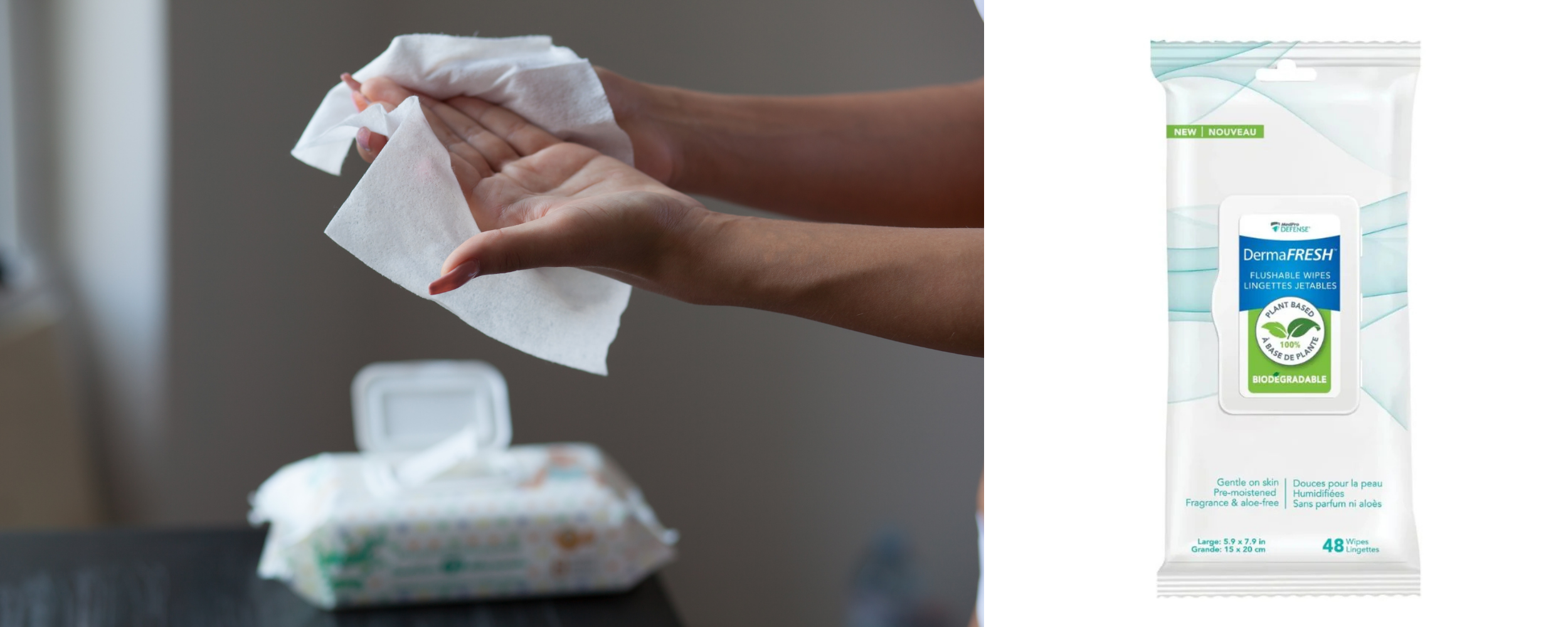
Pre-Moistened Wipes
The most common format — ready to use straight from the pack, with no water or rinsing required. These are typically enriched with ingredients like aloe vera or vitamin E to help support skin comfort during frequent use, and many are formulated to be pH-balanced or fragrance-free for sensitive skin.
Dry Wipes
Dry wipes are used either on their own, dampened with water, or paired with a separate cleansing solution, barrier cream, or skin care product. This format gives caregivers and facilities more control over exactly what touches the skin — useful in settings where a specific cleansing protocol or product is already in place.
Flushable & Maceratable Wipes
"Flushable" is a term worth understanding carefully. A genuinely flushable wipe is maceratable — meaning its fiber structure is engineered to break apart when agitated in water, similar to toilet paper. This matters because many wipes on the market are labelled "flushable" without actually breaking down, which can contribute to plumbing blockages and municipal sewage issues. When choosing a flushable wipe, look for products that are explicitly described as maceratable, and always flush one wipe at a time regardless of the claim.
Fragrance-Free & Hypoallergenic Wipes
For sensitive skin, clinical environments, or anyone with fragrance intolerances, fragrance-free wipes remove one of the most common sources of irritation. Some go further and are also free from other common irritants like alcohol, dyes, latex, and parabens — worth checking the label if allergies or skin sensitivity are a concern.
Common Use Cases
Bed bathing: In clinical and home care settings alike, personal care wipes are often used for full or partial bed baths when a resident or patient can't access a shower or bath. Large-format wipes (often 8" x 12" or larger) are typically preferred here for efficient coverage.
Continence and perineal care: This is one of the most sensitive and frequent use cases for personal care wipes, particularly for individuals managing incontinence or recovering from surgery. Gentle, pH-balanced, fragrance-free formulas are especially important here, since this skin is exposed to more frequent cleansing than most other areas of the body.
General hygiene and freshening: Outside of clinical contexts, personal care wipes are commonly used for everyday freshening, travel, and situations where access to water is limited.

What to Look for When Choosing a Personal Care Wipe
- Skin pH and the acid mantle: Healthy skin maintains a slightly acidic pH, often referred to as the acid mantle, which acts as a natural barrier against irritation and infection. This barrier can be more fragile in aging skin or skin that's cleansed frequently, which is why pH-balanced formulas are often recommended for continence care and repeated daily use.
- Ingredient sensitivities: Fragrance, alcohol, dyes, and parabens are common triggers for skin irritation. If you're choosing wipes for someone with known sensitivities, or for a clinical setting where ingredient control matters, look for products that explicitly list what they're free from.
- Moisture-associated skin damage (MASD): This is a recognized concern in long-term care and continence care settings, where skin that's frequently exposed to moisture — from incontinence, sweat, or repeated cleansing — becomes more vulnerable to breakdown. Gentle, pH-balanced, non-irritating wipes are one part of a broader approach to reducing this risk, alongside proper skin barrier products and care protocols.
- Dispensing and format: For high-volume settings like long-term care facilities, dispensing design matters more than it might seem. Wipes that dispense one at a time (rather than pulling out in a tangled chain, sometimes called "roping") can meaningfully speed up caregiver routines during busy shifts.
- Flushability, if relevant: If wipes will be disposed of via toilet, confirm they're genuinely maceratable rather than simply labelled "flushable." If in doubt, disposing of wipes in a waste bin is always the safer option for plumbing and septic systems.
Personal Care Wipes vs. Baby Wipes
Though they're mechanically similar — both are pre-moistened cleansing wipes — personal care wipes for adults and baby wipes are typically formulated and marketed differently. Baby wipes are generally unscented and designed specifically for delicate infant skin during diaper changes, while adult personal care wipes are more likely to be sized for full-body or continence care use and may include ingredients like aloe vera or vitamin E aimed at skin barrier support in older or more fragile skin. It's worth choosing a wipe formulated for its intended use case rather than assuming one type is interchangeable with the other.
Choosing the Right Wipe for Your Situation
Home Caregiver
Look for a gentle, fragrance-free or lightly scented pre-moistened wipe with good coverage size. If flushability is important for your household, confirm the product is genuinely maceratable.
Facility / Clinical Setting
Prioritize pH-balanced, fragrance-free formulas designed for frequent use, along with dispensing features that support caregiver efficiency across high patient volumes.
Managing Your Own Continence Care
A hypoallergenic, fragrance-free, pH-balanced wipe is generally the safest starting point, particularly if you're prone to irritation.
Full Control Over Ingredients
A dry wipe format lets you pair the cloth with whatever cleansing solution or barrier product already works for your skin.
Frequently Asked Questions
Are all "flushable" wipes actually safe to flush?
Not necessarily. Many wipes marketed as flushable don't fully break down in water and can contribute to plumbing and sewage system blockages. Genuinely flushable wipes are described as maceratable, meaning their fibers are engineered to disperse in water. When in doubt, dispose of wipes in a waste bin.
Why does fragrance-free matter for personal care wipes?
Added fragrance is one of the most common causes of skin irritation, particularly for sensitive skin, aging skin, or skin exposed to frequent cleansing. Fragrance-free formulas reduce this risk and are often recommended for continence care and clinical use.
What's the difference between dry wipes and pre-moistened wipes?
Pre-moistened wipes are ready to use straight from the pack. Dry wipes require water or a separate cleansing solution but offer more control over exactly what products contact the skin — useful for facilities or individuals with a specific care protocol already in place.
Are personal care wipes safe for daily use?
Many are specifically formulated for daily or multiple-times-daily use, particularly in continence care. Choosing a pH-balanced, fragrance-free formula can help minimize irritation with frequent use, though individual skin sensitivity varies.
Can I use the same wipes for bed bathing and continence care?
Some products are designed for full-body versatility and can be used for both. Others are more specifically formulated or sized for one use case. Checking the product's intended use and size is the best way to confirm it fits your needs.
Final Thoughts
Personal care wipes aren't a one-size-fits-all product — the right choice depends on the skin being cared for, the setting, and what matters most to you, whether that's flushability, fragrance-free ingredients, or dispensing convenience for high-volume care. Taking a few minutes to match the product to the use case can make a meaningful difference in comfort, skin health, and day-to-day care routines.
