
Storage is one of those exam room decisions that doesn’t get much attention until it’s wrong. Supplied end up on counters, staff walk out of the room mid-appointment to find a box of gloves, or a cabinet that looked great in the catalog turns out to be too deep for the space. The right cabinet depends on how your staff work in the room: what gets used for every appointment, what only gets used occasionally, and whether supplies need to move from room to room.
This guide walks through four cabinets from the Surgo exam room range, covering three decisions that matter most: whether to go mobile or stationary, how to split storage between drawers and doors, and which finish suits your setting.
Cart-Based Storage vs. Built-In Cabinetry
Two of the cabinets below move, and two stay put. One note on terms: all four are freestanding units rather than permanently installed millwork, so “built-in” here really means stationary cabinetry that stays in one place.
Mobile and Cart-Based Options
A mobile unit makes sense when supplies need to travel with the practitioner, such as between exam rooms, or when you want to pull a cart up beside a patient for a procedure and wheel it away afterward.
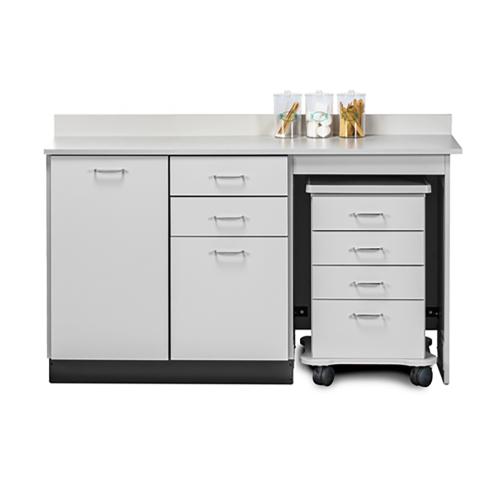
- Clinton Cart Mate Cabinet with Cart Right, Grey – Item Code: 301-48060R. A hybrid setup: a base cabinet with a dedicated cart port, plus a laminate cart with four soft-close drawers on 3” swivel casters. The cart can be rolled out for use and parked back in the cabinet. The cart has a plastic bumper and a vacuum-formed, textured top that’s rimmed on all sides to help keep items from sliding off. The unit arrives pre-assembled.
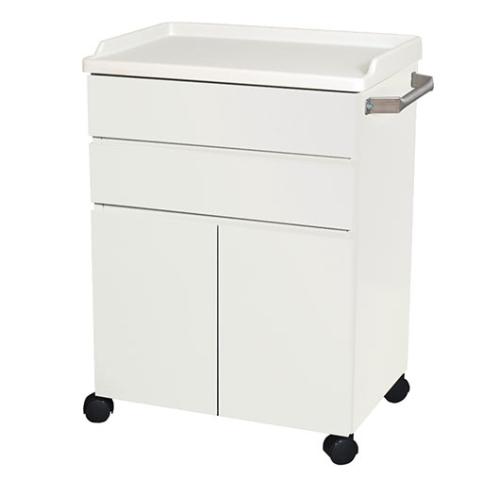
- Modular Treatment Cabinet, Two Drawers/Two Doors, Stainless Steel – Item Code: 301-6214. A compact, mobile cabinet on 2” twin-wheel carpet casters with a stainless steel push handle. It has a seamless Kydex top with an integrated rail to keep supplies in place during transport. At 25” wide, 18” deep, and 34.25” high, it works as a rolling work surface as well as storage.
Stationary Cabinetry
Stationary cabinets suit supplies that stay in the room: stock for the day, instruments, and bulk items. These two tall UMF units rest on adjustable leveling glides, which helps keep them stable or uneven floors.
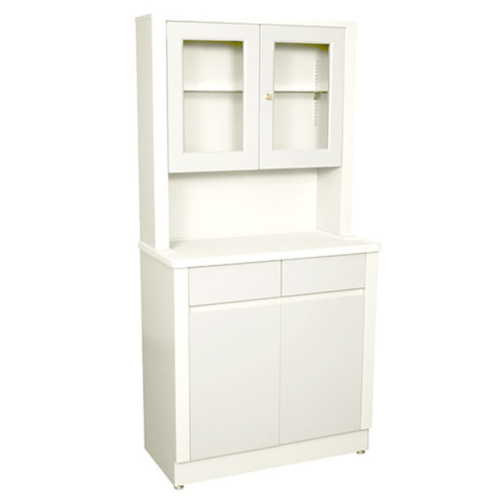
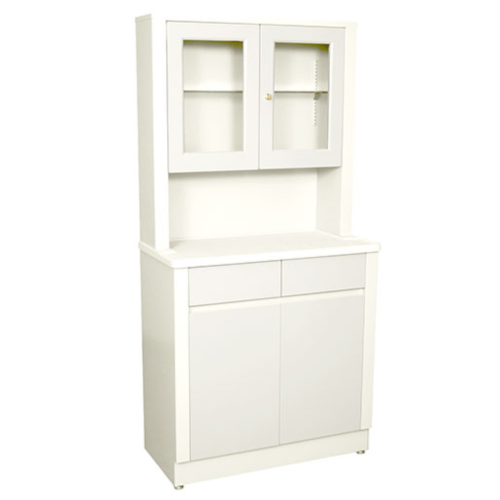
- UMF Treatment Cabinet with Upper Section, 2 Doors, 2 Drawers & Shelf, Quiet White – Item Code: 301-6117QW. Combines a Kydex work surface with storage above and below. At 32” wide, 16.25” deep, and 65” high, it gives a room a workspace and a supply cabinet in a single footprint.
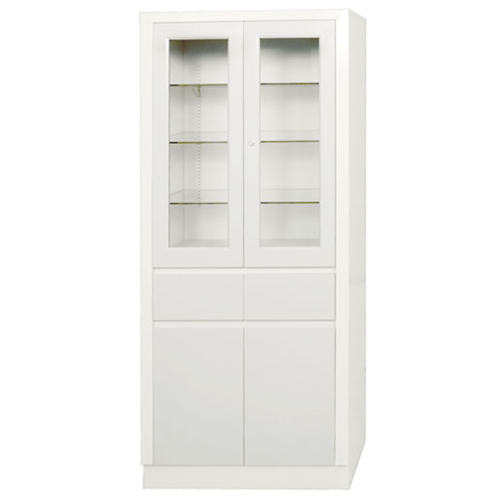
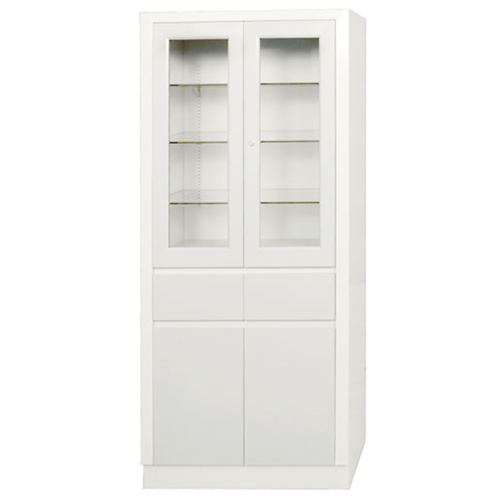
- UMF Storage Cabinet with Upper Section, 2 Doors & 2 Drawers, Quiet White – Item Code: 301-7142QW. A storage-focused unit at 31.5” wide, 15.5” deep, and 66.5” high, with more adjustable shelving in the upper section than the 6117.
How to Decide
- Do supplies need to move between rooms or around the room? Choose a mobile cabinet or a cabinet-and-cart combination.
- Is floor space tight? Compare footprints before you buy. The 6214 is the narrowest at 25” wide, and the two tall UMF units are around 32” wide but only 15.5” to 16.25” deep.
- Do you need a work surface in the room? The 6117 and 6214 both include a Kydex top. The 7142 is better for pure storage.
- Would a combination make sense? Many rooms do well with one stationary cabinet for stock and one mobile unit for procedure.
Choosing Between Drawer and Door Configurations
All four cabinets mix drawers and doors, but they split the storage differently. A good rule of thumb: put what you reach for during an appointment in drawers, and put bulk or bigger items behind doors.
Drawers: Everyday Access
Drawers keep smaller items organized and easy to see from above, so they suit gloves, dressings, instruments and anything grabbed mid-procedure.
- Clinton Cart Mate (301-48060R) has two drawers in the base cabinet and four soft-close drawers in the cart. The cabinet drawers have one-piece metal sides rated for up to 75 lbs.
- UMF 6214 (301-6214) has two drawers on full-extension roller bearing glides, so you can see and reach the entire drawer.
- UMF 6117 (301-6117QW) has two lockable lower drawers, useful for items you’d rather keep secured.
- UMF 7142 (301-7142QW) has two drawers in the lower section.
Doors: Bulk and Larger Items
Closed lower cabinets are better for larger boxes, bulk supplies, and anything that doesn’t need to be seen all day.
- The Clinton Cart Mate base cabinet has two doors with two adjustable shelves, plus soft-close hinges.
- The UMF 6117, 6214, and 7142 each have a lower two-door cabinet. On the 6117 and 7142, the lower section includes a removable metal shelf.
Glass-Front Upper Cabinets: Visibility and Security
The two tall UMF units add an upper cabinet with glass-pane doors. Staff can see what’s in stock at a glance, and the doors lock.
- The 6117 has lockable glass-pane doors and one adjustable glass shelf, plus a safety release latch on the upper left door.
- The 7142 has two lockable glass-pane doors, with a standard lock on the upper right door and a safety release level on the upper left. It includes three adjustable glass shelves, which gives you more flexibility for different-sized items.
One thing to think through: glass doors mean patients can see what’s inside. Many practices keep tidy, non-sensitive stock on display and use the lockable drawers and closed lower cabinets for everything else.
Matching Finish (Laminate vs. Stainless Steel) to Your Setting
Laminate
The Clinton Cart Mate is built with all-laminate surfaces and chip-resistant edges, designed to be easy to clean. It also includes a 3.25” backsplash to protect the wall behind the cabinet, and satin finish pulls. Laminate is a good fit for general exam rooms and clinics where the look of the room matters as much as the function.
Steel and Stainless Steel
The three UMF cabinets are all built from 20-gauge steel. The 6117 and 7142 come in a Quiet White finish that suits most clinical spaces, while the 6214 is listed as stainless steel, with a stainless steel push handle and a Kydex top. UMF describes the 6214’s seamless Kydex top as a durable, chemical-resistant work surface, which is useful when the surface gets wiped down with disinfectants throughout the day.
Matching the Finish to the Room
- General exam rooms and family practice: Laminate or Quiet White steel both work well, so choose based on the look of the room and storage layout you need.
- Procedure and treatment rooms: Prioritize a wipe-down work surface. The Kydex tops on the 6117 and 6214 are designed for this.
- Rooms with frequent cleaning: Look for sealed or seamless surfaces and minimal crevices where residue collects. Chip-resistant laminate edges and seamless Kydex tops both help here.
- Rooms where visual consistency matters: A shared finish across cabinets helps a room look cohesive. The two Quiet White UMF units pair well together.
Comparing the Four Cabinets at a Glance
| Product | Item Code | Mobility | Drawers | Doors and Shelving | Surfaces and Finish |
| Clinton Cart Mate Cabinet with Cart Right, Grey | 301-48060R | Cart on 3” swivel casters; base cabinet stationary | 2 in cabinet; 4 soft-close in cart | 2 doors, 2 adjustable shelves | Laminate, textured cart top, 3.25” backsplash |
| UMF Treatment Cabinet with Upper Section, Quiet White | 301-6117QW | Stationary (leveling glides) | 2 lockable | Lower 2 doors with removable metal shelf; upper glass-pane doors with 1 adjustable glass shelf | 20-gauge steel, Kydex work surface |
| Modular Treatment Cabinet, Stainless Steel | 301-6214 | Mobile (2” twin-wheel carpet casters, push handle) | 2 full-extension | Lower 2-door cabinet | 20-gauge steel, stainless steel push handle, Kydex top with rail |
| UMF Storage Cabinet with Upper Section, Quiet White | 301-7142QW | Stationary (leveling glides) | 2 | Lower 2 doors with removable metal shelf; upper glass-pane doors with 3 adjustable glass shelves | 20-gauge steel; work surface not listed |
Final Thoughts
There’s no single best cabinet; it depends on how your room works. If supplies move with your practitioners, a mobile unit like the Clinton Cart Mate or the UMF 6214 earns its place. If your room needs a work surface plus secure storage, the UMF 6117 covers both in one footprint. And if the priority is visible, organized stock with lots of adjustable shelving, the UMF 7142 is the storage-first option. Check the dimensions against your room before you commit, and keep drawers for what you grab during appointments and doors for everything else. That one habit makes the biggest difference to how smoothly the room runs.
Frequently Asked Questions
Should I choose a mobile or stationary cabinet for my exam room?
Choose mobile if supplies need to travel between rooms or be positioned next to the patient during a procedure. Choosing stationary if the stock stays in the room and you want maximum storage in a fixed footprint. Many practices use one of each.
Are glass-front cabinets a good idea in an exam room?
They let staff see stock levels at a glance, and the UMF 6117 and 7142 both have lockable glass-pane doors. Because patients can see through the glass, keep neatly organized, non-sensitive items in the upper section and use drawers and closed lower cabinets for the rest.
Which of these cabinets can be locked?
The UMF 6117 has lockable upper glass-pane doors and two lockable lower drawers. The UMF 7142 has lockable upper glass-pane doors, with a standard lock on the upper right door. The listings for the Clinton Cart Mate and the UMF 6214 don’t mention locks.
How much floor space do these cabinets need?
The UMF 6214 measures 25” wide by 18” deep. The UMF 6117 is 32” wide by 16.25” deep, and the UMF 7142 is 31.5” wide by 15.5” deep. Dimensions for the Clinton Cart Mate aren’t listed here, so check the product page or contact us before planning a layout around it.
What is a Kydex work surface?
Kydex is a durable thermoplastic sheet material. UMF describes the seamless Kydex top on the 6214 as a durable, chemical-resistant surface, which makes it a practical choice for a treatment counter that gets cleaned frequently. Both the UMF 6117 and 6214 use a Kydex work surface.




Storage is one of those exam room decisions that doesn’t get much attention until it’s wrong. Supplied end up on counters, staff walk out of the room mid-appointment to find a box of gloves, or a cabinet that looked great in the catalog turns out to be too deep for the space. The right cabinet depends on how your staff work in the room: what gets used for every appointment, what only gets used occasionally, and whether supplies need to move from room to room.
This guide walks through four cabinets from the Surgo exam room range, covering three decisions that matter most: whether to go mobile or stationary, how to split storage between drawers and doors, and which finish suits your setting.
Cart-Based Storage vs. Built-In Cabinetry
Two of the cabinets below move, and two stay put. One note on terms: all four are freestanding units rather than permanently installed millwork, so “built-in” here really means stationary cabinetry that stays in one place.
Mobile and Cart-Based Options
A mobile unit makes sense when supplies need to travel with the practitioner, such as between exam rooms, or when you want to pull a cart up beside a patient for a procedure and wheel it away afterward.
- Clinton Cart Mate Cabinet with Cart Right, Grey – Item Code: 301-48060R. A hybrid setup: a base cabinet with a dedicated cart port, plus a laminate cart with four soft-close drawers on 3” swivel casters. The cart can be rolled out for use and parked back in the cabinet. The cart has a plastic bumper and a vacuum-formed, textured top that’s rimmed on all sides to help keep items from sliding off. The unit arrives pre-assembled.
- Modular Treatment Cabinet, Two Drawers/Two Doors, Stainless Steel – Item Code: 301-6214. A compact, mobile cabinet on 2” twin-wheel carpet casters with a stainless steel push handle. It has a seamless Kydex top with an integrated rail to keep supplies in place during transport. At 25” wide, 18” deep, and 34.25” high, it works as a rolling work surface as well as storage.
Stationary Cabinetry
Stationary cabinets suit supplies that stay in the room: stock for the day, instruments, and bulk items. These two tall UMF units rest on adjustable leveling glides, which helps keep them stable or uneven floors.
- UMF Treatment Cabinet with Upper Section, 2 Doors, 2 Drawers & Shelf, Quiet White – Item Code: 301-6117QW. Combines a Kydex work surface with storage above and below. At 32” wide, 16.25” deep, and 65” high, it gives a room a workspace and a supply cabinet in a single footprint.
- UMF Storage Cabinet with Upper Section, 2 Doors & 2 Drawers, Quiet White – Item Code: 301-7142QW. A storage-focused unit at 31.5” wide, 15.5” deep, and 66.5” high, with more adjustable shelving in the upper section than the 6117.
How to Decide
- Do supplies need to move between rooms or around the room? Choose a mobile cabinet or a cabinet-and-cart combination.
- Is floor space tight? Compare footprints before you buy. The 6214 is the narrowest at 25” wide, and the two tall UMF units are around 32” wide but only 15.5” to 16.25” deep.
- Do you need a work surface in the room? The 6117 and 6214 both include a Kydex top. The 7142 is better for pure storage.
- Would a combination make sense? Many rooms do well with one stationary cabinet for stock and one mobile unit for procedure.
Choosing Between Drawer and Door Configurations
All four cabinets mix drawers and doors, but they split the storage differently. A good rule of thumb: put what you reach for during an appointment in drawers, and put bulk or bigger items behind doors.
Drawers: Everyday Access
Drawers keep smaller items organized and easy to see from above, so they suit gloves, dressings, instruments and anything grabbed mid-procedure.
- Clinton Cart Mate (301-48060R) has two drawers in the base cabinet and four soft-close drawers in the cart. The cabinet drawers have one-piece metal sides rated for up to 75 lbs.
- UMF 6214 (301-6214) has two drawers on full-extension roller bearing glides, so you can see and reach the entire drawer.
- UMF 6117 (301-6117QW) has two lockable lower drawers, useful for items you’d rather keep secured.
- UMF 7142 (301-7142QW) has two drawers in the lower section.
Doors: Bulk and Larger Items
Closed lower cabinets are better for larger boxes, bulk supplies, and anything that doesn’t need to be seen all day.
- The Clinton Cart Mate base cabinet has two doors with two adjustable shelves, plus soft-close hinges.
- The UMF 6117, 6214, and 7142 each have a lower two-door cabinet. On the 6117 and 7142, the lower section includes a removable metal shelf.
Glass-Front Upper Cabinets: Visibility and Security
The two tall UMF units add an upper cabinet with glass-pane doors. Staff can see what’s in stock at a glance, and the doors lock.
- The 6117 has lockable glass-pane doors and one adjustable glass shelf, plus a safety release latch on the upper left door.
- The 7142 has two lockable glass-pane doors, with a standard lock on the upper right door and a safety release level on the upper left. It includes three adjustable glass shelves, which gives you more flexibility for different-sized items.
One thing to think through: glass doors mean patients can see what’s inside. Many practices keep tidy, non-sensitive stock on display and use the lockable drawers and closed lower cabinets for everything else.
Matching Finish (Laminate vs. Stainless Steel) to Your Setting
Laminate
The Clinton Cart Mate is built with all-laminate surfaces and chip-resistant edges, designed to be easy to clean. It also includes a 3.25” backsplash to protect the wall behind the cabinet, and satin finish pulls. Laminate is a good fit for general exam rooms and clinics where the look of the room matters as much as the function.
Steel and Stainless Steel
The three UMF cabinets are all built from 20-gauge steel. The 6117 and 7142 come in a Quiet White finish that suits most clinical spaces, while the 6214 is listed as stainless steel, with a stainless steel push handle and a Kydex top. UMF describes the 6214’s seamless Kydex top as a durable, chemical-resistant work surface, which is useful when the surface gets wiped down with disinfectants throughout the day.
Matching the Finish to the Room
- General exam rooms and family practice: Laminate or Quiet White steel both work well, so choose based on the look of the room and storage layout you need.
- Procedure and treatment rooms: Prioritize a wipe-down work surface. The Kydex tops on the 6117 and 6214 are designed for this.
- Rooms with frequent cleaning: Look for sealed or seamless surfaces and minimal crevices where residue collects. Chip-resistant laminate edges and seamless Kydex tops both help here.
- Rooms where visual consistency matters: A shared finish across cabinets helps a room look cohesive. The two Quiet White UMF units pair well together.
Comparing the Four Cabinets at a Glance
| Product | Item Code | Mobility | Drawers | Doors and Shelving | Surfaces and Finish |
| Clinton Cart Mate Cabinet with Cart Right, Grey | 301-48060R | Cart on 3” swivel casters; base cabinet stationary | 2 in cabinet; 4 soft-close in cart | 2 doors, 2 adjustable shelves | Laminate, textured cart top, 3.25” backsplash |
| UMF Treatment Cabinet with Upper Section, Quiet White | 301-6117QW | Stationary (leveling glides) | 2 lockable | Lower 2 doors with removable metal shelf; upper glass-pane doors with 1 adjustable glass shelf | 20-gauge steel, Kydex work surface |
| Modular Treatment Cabinet, Stainless Steel | 301-6214 | Mobile (2” twin-wheel carpet casters, push handle) | 2 full-extension | Lower 2-door cabinet | 20-gauge steel, stainless steel push handle, Kydex top with rail |
| UMF Storage Cabinet with Upper Section, Quiet White | 301-7142QW | Stationary (leveling glides) | 2 | Lower 2 doors with removable metal shelf; upper glass-pane doors with 3 adjustable glass shelves | 20-gauge steel; work surface not listed |
Final Thoughts
There’s no single best cabinet; it depends on how your room works. If supplies move with your practitioners, a mobile unit like the Clinton Cart Mate or the UMF 6214 earns its place. If your room needs a work surface plus secure storage, the UMF 6117 covers both in one footprint. And if the priority is visible, organized stock with lots of adjustable shelving, the UMF 7142 is the storage-first option. Check the dimensions against your room before you commit, and keep drawers for what you grab during appointments and doors for everything else. That one habit makes the biggest difference to how smoothly the room runs.
Frequently Asked Questions
Should I choose a mobile or stationary cabinet for my exam room?
Choose mobile if supplies need to travel between rooms or be positioned next to the patient during a procedure. Choosing stationary if the stock stays in the room and you want maximum storage in a fixed footprint. Many practices use one of each.
Are glass-front cabinets a good idea in an exam room?
They let staff see stock levels at a glance, and the UMF 6117 and 7142 both have lockable glass-pane doors. Because patients can see through the glass, keep neatly organized, non-sensitive items in the upper section and use drawers and closed lower cabinets for the rest.
Which of these cabinets can be locked?
The UMF 6117 has lockable upper glass-pane doors and two lockable lower drawers. The UMF 7142 has lockable upper glass-pane doors, with a standard lock on the upper right door. The listings for the Clinton Cart Mate and the UMF 6214 don’t mention locks.
How much floor space do these cabinets need?
The UMF 6214 measures 25” wide by 18” deep. The UMF 6117 is 32” wide by 16.25” deep, and the UMF 7142 is 31.5” wide by 15.5” deep. Dimensions for the Clinton Cart Mate aren’t listed here, so check the product page or contact us before planning a layout around it.
What is a Kydex work surface?
Kydex is a durable thermoplastic sheet material. UMF describes the seamless Kydex top on the 6214 as a durable, chemical-resistant surface, which makes it a practical choice for a treatment counter that gets cleaned frequently. Both the UMF 6117 and 6214 use a Kydex work surface.
