
These three treatments get grouped together often, and it’s easy to see why – all three promise smoother, brighter, more even-looking skin, and all three are non-invasive with little to no downtime. But they work in genuinely different ways, and knowing what actually happens during each one makes it much easier to choose the right treatment (or combination) for your skin.
How Each Treatment Works
Dermaplaning
A trained practitioner uses a fine surgical blade, held at a shallow angle to manually scrape away the outermost layer of dead skin cells along with vellus hair (fine facial “peach fuzz”). It’s a purely physical, blade-based technique with no chemicals or suction involved.
Microdermabrasion
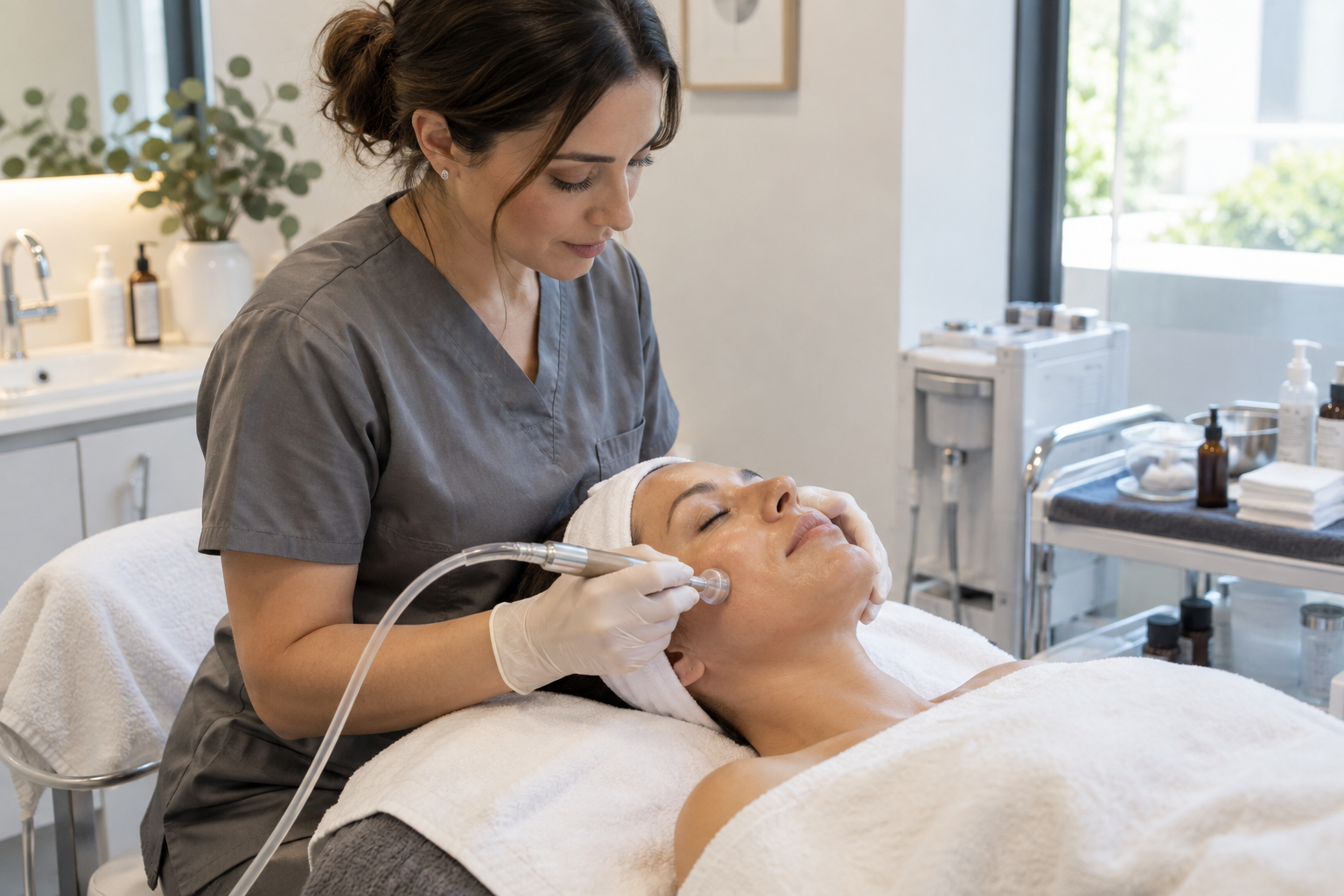
A handheld device is used to mechanically exfoliate the skin’s surface, either by spraying fine crystals across the skin or using a diamond-tipped wand, then vacuuming away the loosened dead skin cells. Unlike dermaplaning, it doesn’t remove facial hair – its entire job is surface exfoliation.
HydraFacial
A multi-step treatment performed with a specialized device that cleanses, exfoliates, extracts debris from pores, and infuses the skin with hydrating serums, typically in a single continuous session. It combines exfoliation with hydration and product delivery, rather than focusing on exfoliation alone.
What Each Treatment Is Best For
Dermaplaning: Hair and Texture Together
Dermaplaning is the only one of the three that removes vellus hair, which makes it a strong choice for people whose main concern includes visible facial hair alongside dull texture. It also creates an extremely smooth surface, which is why it’s popular before events or photos when makeup needs to sit as evenly as possible.
Microdermabrasion: Texture and Tone
Microdermabrasion is well suited to improving rough texture, mild hyperpigmentation, and dullness through mechanical exfoliation. Because it doesn’t remove hair, it’s a better fit for people whose concern is purely about skin texture rather than visible peach fuzz.
HydraFacial: Hydration Plus Exfoliation
HydraFacial tends to appeal to people looking for a more comprehensive treatment – exfoliation, pore cleaning, and hydration in one session – rather than exfoliation on its own. It’s often chosen by people with dry or dehydrated skin who want a noticeable hydration boost alongside smoother texture.
Downtime and Sensitivity
Dermaplaning
Essentially no downtime. Skin may be slightly more sensitive for a day or two, with mild redness that typically settles within a few hours of treatment.
Microdermabrasion
Also minimal downtime, though skin can appear slightly pink immediately afterward, similar to a light sunburn, which usually fades within a few hours to a day depending on treatment intensity.
HydraFacial
Typically the gentlest of the three in terms of sensitivity, since the process is designed to hydrate as it exfoliates. Most people see little to no visible redness and can return to normal activities immediately.
Can They Be Combined or Alternated?

Combining in One Visit
Some clinics perform dermaplaning immediately before a HydraFacial or another hydrating treatment, since the freshly exfoliated skin can allow serums and hydration steps to absorb more effectively afterward. This isn’t standard everywhere, so it’s worth asking your provider whether they offer this combination.
Alternating Over Time
Because these treatments work differently, some people rotate between them based on what their skin needs at a given time – for example, dermaplaning before an event for the smoothest possible finish, and HydraFacial during a period focused on hydration. A provider can help build a treatment schedule based on your skin’s changing needs rather than sticking to just one option indefinitely.
Final Thoughts
There isn’t a single “best” treatment among these three – the right choice depends on what your skin actually needs. Dermaplaning stands out for anyone dealing with visible facial hair alongside texture concerns, microdermabrasion is a solid option for texture and tone without touching hair, and HydraFacial suits people prioritizing hydration alongside exfoliation. Many people end up using more than one over time rather than picking just one for good, and a consultation with a licensed provider is the simplest way to figure out which fits your skin right now.
Frequently Asked Questions
Which is better: dermaplaning or microdermabrasion?
Neither is universally “better” - they target slightly different things. Dermaplaning removes both dead skin and facial hair, while microdermabrasion focuses purely on mechanical exfoliation of the skin’s surface. The better choice depends on whether visible facial hair is part of your concern.
Can I get a HydraFacial after dermaplaning?
Some providers do perform them together, with dermaplaning first to remove the outer layer before the HydraFacial’s hydration and extraction steps. Ask your specific provider whether this is something they offer and whether it’s a good fit for your skin.
Which treatment has the least downtime?
All three are generally low-downtime treatments, but HydraFacial tends to cause the least visible redness or sensitivity immediately afterward, since it’s designed to hydrate throughout the process.
Do these treatments help with acne scarring?
Microdermabrasion and HydraFacial can offer mild improvement in the appearance of superficial texture irregularities over a series of sessions, but none of these three treatments are designed to significantly treat deeper acne scarring. A provider can recommend more targeted options if scarring is your main concern.
How often can I get each of these treatments?
This varies by treatment and by individual skin, but dermaplaning is often spaced around every 3 to 4 weeks to align with the skin’s natural cell turnover cycle, while microdermabrasion and HydraFacial frequency recommendations vary by provider and skin sensitivity. Your provider can recommend a schedule based on your skin’s response.
These three treatments get grouped together often, and it’s easy to see why – all three promise smoother, brighter, more even-looking skin, and all three are non-invasive with little to no downtime. But they work in genuinely different ways, and knowing what actually happens during each one makes it much easier to choose the right treatment (or combination) for your skin.
How Each Treatment Works
Dermaplaning
A trained practitioner uses a fine surgical blade, held at a shallow angle to manually scrape away the outermost layer of dead skin cells along with vellus hair (fine facial “peach fuzz”). It’s a purely physical, blade-based technique with no chemicals or suction involved.
Microdermabrasion
A handheld device is used to mechanically exfoliate the skin’s surface, either by spraying fine crystals across the skin or using a diamond-tipped wand, then vacuuming away the loosened dead skin cells. Unlike dermaplaning, it doesn’t remove facial hair – its entire job is surface exfoliation.
HydraFacial
A multi-step treatment performed with a specialized device that cleanses, exfoliates, extracts debris from pores, and infuses the skin with hydrating serums, typically in a single continuous session. It combines exfoliation with hydration and product delivery, rather than focusing on exfoliation alone.
What Each Treatment Is Best For
Dermaplaning: Hair and Texture Together
Dermaplaning is the only one of the three that removes vellus hair, which makes it a strong choice for people whose main concern includes visible facial hair alongside dull texture. It also creates an extremely smooth surface, which is why it’s popular before events or photos when makeup needs to sit as evenly as possible.
Microdermabrasion: Texture and Tone
Microdermabrasion is well suited to improving rough texture, mild hyperpigmentation, and dullness through mechanical exfoliation. Because it doesn’t remove hair, it’s a better fit for people whose concern is purely about skin texture rather than visible peach fuzz.
HydraFacial: Hydration Plus Exfoliation
HydraFacial tends to appeal to people looking for a more comprehensive treatment – exfoliation, pore cleaning, and hydration in one session – rather than exfoliation on its own. It’s often chosen by people with dry or dehydrated skin who want a noticeable hydration boost alongside smoother texture.
Downtime and Sensitivity
Dermaplaning
Essentially no downtime. Skin may be slightly more sensitive for a day or two, with mild redness that typically settles within a few hours of treatment.
Microdermabrasion
Also minimal downtime, though skin can appear slightly pink immediately afterward, similar to a light sunburn, which usually fades within a few hours to a day depending on treatment intensity.
HydraFacial
Typically the gentlest of the three in terms of sensitivity, since the process is designed to hydrate as it exfoliates. Most people see little to no visible redness and can return to normal activities immediately.
Can They Be Combined or Alternated?
Combining in One Visit
Some clinics perform dermaplaning immediately before a HydraFacial or another hydrating treatment, since the freshly exfoliated skin can allow serums and hydration steps to absorb more effectively afterward. This isn’t standard everywhere, so it’s worth asking your provider whether they offer this combination.
Alternating Over Time
Because these treatments work differently, some people rotate between them based on what their skin needs at a given time – for example, dermaplaning before an event for the smoothest possible finish, and HydraFacial during a period focused on hydration. A provider can help build a treatment schedule based on your skin’s changing needs rather than sticking to just one option indefinitely.
Final Thoughts
There isn’t a single “best” treatment among these three – the right choice depends on what your skin actually needs. Dermaplaning stands out for anyone dealing with visible facial hair alongside texture concerns, microdermabrasion is a solid option for texture and tone without touching hair, and HydraFacial suits people prioritizing hydration alongside exfoliation. Many people end up using more than one over time rather than picking just one for good, and a consultation with a licensed provider is the simplest way to figure out which fits your skin right now.
Frequently Asked Questions
Which is better: dermaplaning or microdermabrasion?
Neither is universally “better” - they target slightly different things. Dermaplaning removes both dead skin and facial hair, while microdermabrasion focuses purely on mechanical exfoliation of the skin’s surface. The better choice depends on whether visible facial hair is part of your concern.
Can I get a HydraFacial after dermaplaning?
Some providers do perform them together, with dermaplaning first to remove the outer layer before the HydraFacial’s hydration and extraction steps. Ask your specific provider whether this is something they offer and whether it’s a good fit for your skin.
Which treatment has the least downtime?
All three are generally low-downtime treatments, but HydraFacial tends to cause the least visible redness or sensitivity immediately afterward, since it’s designed to hydrate throughout the process.
Do these treatments help with acne scarring?
Microdermabrasion and HydraFacial can offer mild improvement in the appearance of superficial texture irregularities over a series of sessions, but none of these three treatments are designed to significantly treat deeper acne scarring. A provider can recommend more targeted options if scarring is your main concern.
How often can I get each of these treatments?
This varies by treatment and by individual skin, but dermaplaning is often spaced around every 3 to 4 weeks to align with the skin’s natural cell turnover cycle, while microdermabrasion and HydraFacial frequency recommendations vary by provider and skin sensitivity. Your provider can recommend a schedule based on your skin’s response.
