
A manual exam table is one of the longest-lasting purchases in a practice, and on paper the options look very similar. Most hold 500 lbs, most have drawers, and most come in a wide range of upholstery colours. The differences show up in daily use: how easy the step is for older patients, whether drawers open from the side you need, and whether the table can adapt as your patient mix changes.
This guide compares five tables from three brands: the Brewer Access 5000 and Brewer Versa, the Ritter 204 by Midmark (with and without a heated drawer), and the UMF 5240. We’ll go through what separates them and how to match a table to your practice.
What to Compare in a Manual Exam Table
Before comparing models, it helps to know which features actually change how a table works day to day. These are the questions worth asking about any manual table:
- How does the patient get on and off? Step size, stability, and surface grip matter most for elderly or mobility-challenged patients.
- Where does storage sit, and how do you reach it? Drawer count, size, and which side they open from affect workflow.
- What weight does it support? Capacity sets the limit on who you can safely examine.
- Can it adapt? Some tables can be reconfigured for different patient groups, and others are built for one use.
- What comes included? Stirrups, a leg extension, a drip pan, an electrical outlet, or a warmed drawer can each be a deciding feature.
The Main Differences Across Brands: Step Design, Storage, Weight Capacity, and Add-On Options
Step Design and Patient Accessibility
None of these tables adjusts in height, so the step is what gets patients up onto the table. Listed table heights are close, ranging from 32” (Brewer Access 5000) to 32.75” (UMF 5240) to 33” (Ritter 204), which makes the step design the real differentiator.
- Brewer Access 5000 (301-5000-24): A large, stable four-leg step. The step surface measures 17.7” x 20.4” and sits 8” high. Brewer describes it as the largest, most secure step on the market, and it’s designed with elderly and mobility-challenged patients in mind.
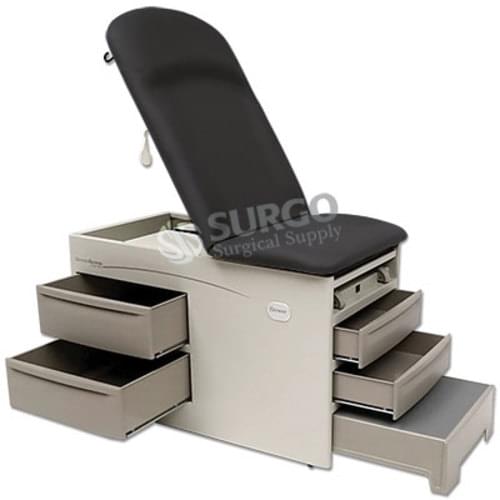
- Brewer Versa (301-1000AX-24): A large, sturdy step with an anti-slip surface, plus multi-position patient assist handles that give patients something to hold during transfers and self-positioning.
.jpg)
- Ritter 204 (301-20401-814 and 301-20402-814): An enlarged foot section that makes it easier for patients to get on the table.
.jpg)
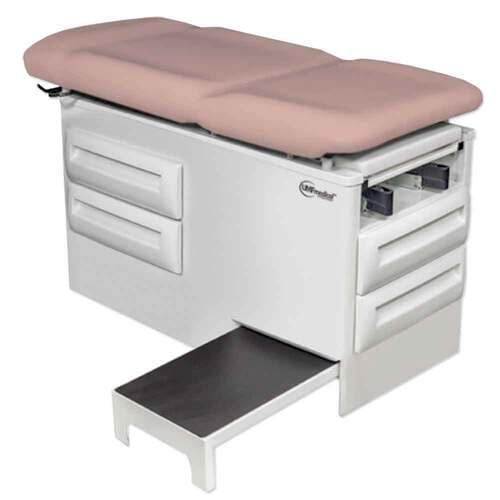
- UMF 5240 (301-52145CB): A pull-out steel non-slip side step, 7” high, that tucks away when not in use.
If many of your patients struggle with any step at all, a manual table may not be the right category. In that case, look at our barrier-free power exam tables, which lower closesr to wheelchair height.
Storage Configuration
Storage is where these tables differ most.
- Brewer Access 5000: A front drawer (19.8” x 19.2” x 3.8”), plus side drawers (22.7” x 20.2” x 7”), plus space under the backrest for up to six additional paper rolls. Brewer describes the storage capacity as the largest available on the market.
- Ritter 204: Three pass-through drawers, all with one-piece, seamless construction designed for easy cleaning.
- UMF 5240: Two front drawers and two reversible side drawers, all on full-extension roller bearing glides and each 18.25” x 15.5” and 4”.
- Brewer Versa: The listing we have doesn’t detail drawer configuration, so check with us before choosing the Versa on storage alone.
Pass-Through Drawers vs. Reversible Drawers
These two designs solve the same problem, which is that practitioners and rooms aren’t set up the same way.
- Pass-through drawers (Brewer Access 5000 and Ritter 204) can be reached from either side of the table. There’s no left- or right-handed setup to get wrong, and an assistant can reach supplies from the opposite side. On the Brewer 5000, drawer stops let you restrict a drawer to open from one side only if you prefer.
- Reversible drawer (UMF 5240) let you set the side drawers up for the side of the table that suits your room layout. UMF’s four-drawer layout (two front, two side) also gives you more separate compartments.
If several practitioners share a room, or you haven’t settled on a layout, pass-through drawers remove the guesswork. If your room layout is fixed and you want more compartments, the UMF’s reversible side drawers are a good fit.
Weight Capacity Across Brands
This is a point of parity: the Brewer Access 5000, Brewer Versa, Ritter 204, and UMF 5240 are all listed at 500 lb. That’s enough for a wide range of patients, but it’s also a ceiling. If your practice regularly sees patients above that weight, look at our bariatric exam table options instead, such as the Ritter 244, which Midmark lists at 850 lb.
Warranty is another place the brands differ even though capacity doesn’t. The Brewer Access 5000 and Versa and the UMF 5240 each list a 5-year warranty (Brewer standard, UMF limited), while the Ritter 204 lists a 1-year warranty.
Pediatric Adaptability
Most manual tables are built for adults, so a practice that sees both adults and children usually has to buy two tables or compromise. The Brewer Versa is the one table in this group designed to change with you patient mix. The other listings here don’t mention pediatric options,
How the Brewer Versa Adapts for Pediatric Patients
- It comes with a removable upholstery top in the standard adult size.
- The top connects easily, and a pediatric top upgrade is available, so the table can be sized for younger patients.
- The stable, cushioned platform, anti-slip step, and patient assist handles stay the same either way.
This is useful for family practices with a shifting mix of adult and pediatric patients, or for a practice that expects its patient base to change over time. Practices that see mainly children may be better served by a dedicated pediatric exam table.
Do You Need a Heated Drawer?
What the Heater Drawer Adds on the Ritter 204
The Ritter 204 comes in two versions that share the same base: 500 lbs capacity, a hospital-grade electrical receptacle on the patient’s left side, an enlarged foot section, a manual back with air spring assist, and a 33” fixed height. The heater model (301-20402-814) add:
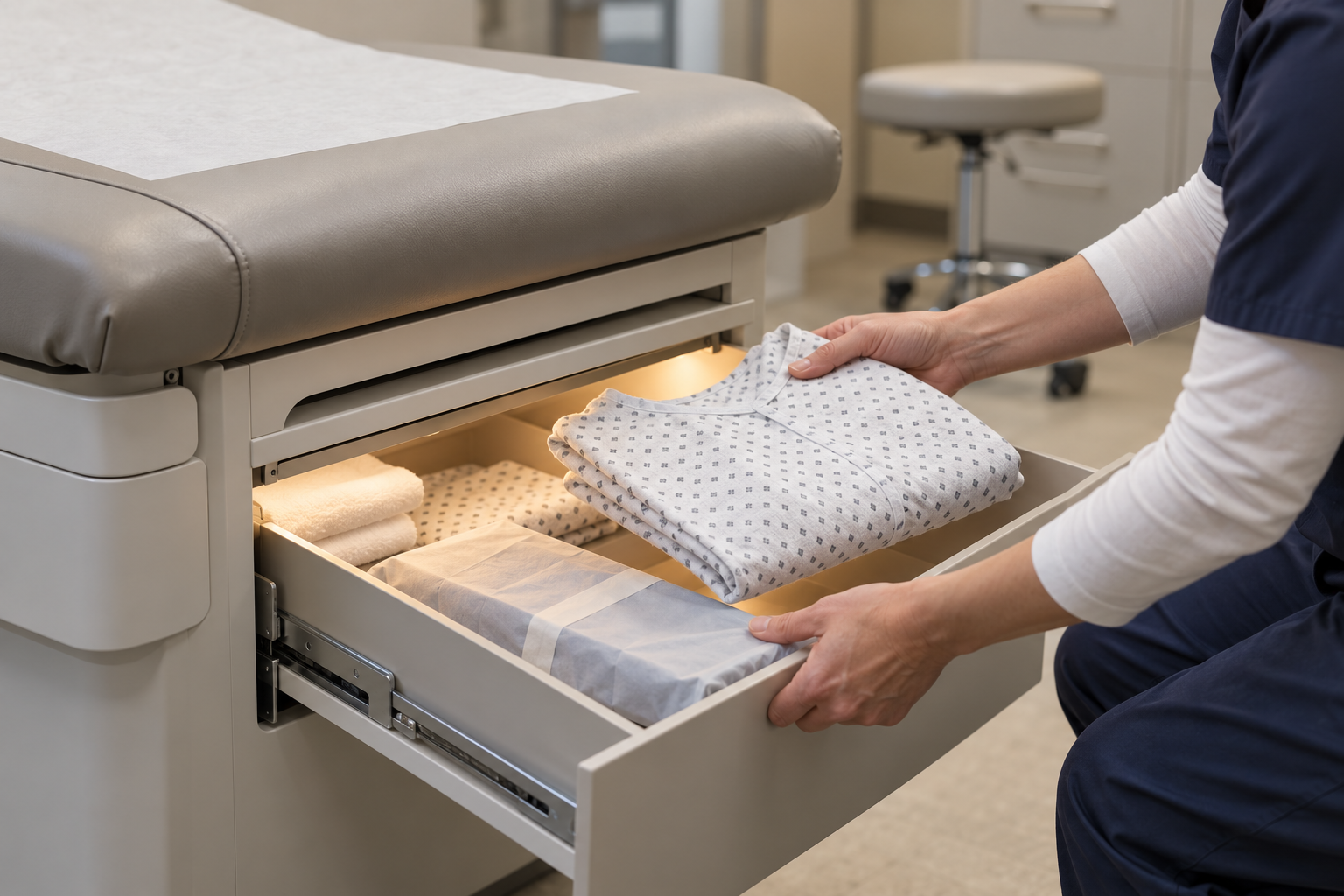
- A 45 W heated drawer. Midmark describes it as warming instruments and materials for added comfort.
- Pelvic tilt. The heater listing includes a 7-degree pelvic tilt, which Midmark says aids in specific examination and procedures.
The electrical spec rises slightly with the heater: 5.5 A at 115 VAC, compared with 5.0 A for the version with just the receptacle.
Patient Comfort Considerations
A cold speculum, a cold gown, or a cold surface can make an already uncomfortable exam feel worse. A warmed drawer helps with that by keeping instruments and materials at a more comfortable temperature, and Midmark’s own description mentions warm blankets for patients. It’s a small feature, but patients tend to notice it, and it can set a different tone for the appointment.
When the Heated Option Is Worth Considering (Practice Type, Patient Population, Climate)
- Practice type: Women’s health and gynecology practices are the obvious fit, especially since the heater model also provides pelvic tilt. Practices that do frequently intimate or invasive exams get more from a warmed drawer than a practice doing mostly quick consults.
- Patient population: Older adults and patients who chill easily tend to appreciate warmth the most. If comfort and anxiety are a regular concern in your patient group, the heated drawer is worth a look.
- Climate: In Canadian winters, patients often arrive cold and may be wearing less than they’d like during an exam. A warmed drawer helps take the edge off.
- When it may not be worth it: If your practice does mostly short, clothed assessments, the standard version covers the essentials. The heated version also needs a power connection and draws slightly more current, so check your room’s outlet setup first.
Choosing the Right Table for Your Practice
- Busy family practice that needs lots of storage: The Brewer Access 5000 has the most storage detail in this group, including pass-through side drawers, a front drawer, and extra paper roll storage. The Ritter 204’s three seamless drawers are a solid alternative if easy cleaning is a priority.
- Mixed adult and pediatric patients: The Brewer Versa is the only table here with a pediatric top upgrade.
- Women’s health: The Ritter 204 with heater adds a warmed drawer and pelvic tilt, and the Brewer 5000 and UMF 5240 both include stirrups. The UMF’s one-touch stirrups have four lateral positions and friction-lock length adjustment.
- Patients who need extra support getting on the table: The Brewer 5000’s large four-leg step and the Versa’s assist handles stand out here.
- Practices that want a built-in step and more compartments: The UMF 5240 includes the pull-out side step, a drip pan, and four drawers.
- Need power at the table: The Ritter 204 includes a standard hospital-grade electrical receptable.
- Warranty matters: Three of the four tables list a 5-year warranty, while the Ritter 204 lists 1 year.
Products in This Guide
| Product | Item Code | Step | Storage | Capacity | Warranty | Notable Features |
| Brewer Access 5000 Series Manual Exam Table, Black Satin | 301-5000-24 | Four-leg step, 17.7" x 20.4" | Pass-through side drawers, front drawer, paper storage under backrest | 500 lb | 5 years | Pneumatic backrest, leg extension with debris tray, adjustable stirrups |
| Brewer Versa Exam Table With Stirrups & Assist Handles, Black Satin | 301-1000AX-24 | Large step, anti-slip surface | Not listed | 500 lb | 5 years | Removable upholstery top, pediatric top upgrade, patient assist handles, stirrups |
| Ritter 204 Manual Exam Table, Stone, Basic Base | 301-20401-814 | Enlarged foot section | Three pass-through drawers | 500 lb | 1 year | Electrical receptacle, paper roll holder, 33" fixed height |
| Ritter 204 Manual Exam Table, Stone, With Heater | 301-20402-814 | Enlarged foot section | Pass-through drawers with 45 W drawer warmer | 500 lb | 1 year | Drawer warmer, pelvic tilt, electrical receptacle |
| UMF 5240-145 Exam Table With Side Step, Cherry Blossom | 301-52145CB | Pull-out steel side step, 7" high | Two front drawers, two reversible side drawers | 500 lb | 5 years (limited) | One-touch stirrups, slide-out leg section, removable drip pan |
The item codes above are the colours we’ve featured. Each of these lines is available in additional upholstery colours.
Final Thoughts
These five tables share a 500 lb capacity, so the decision comes down to the details. Thre Brewer Access 5000 leads on step size and storage detail, the Versa on adaptability, the Ritter 204 on its built-in electrical outlet and optional warmed drawer, and the UMF 5240 on its compartment count and included side step. The best way to choose is to think through your patient mix, your room layout, and the exams you do most often, and pick the table that makes those easier. If you’re unsure, contact us and we’ll help you narrow it down.
Frequently Asked Questions
What’s the difference between pass-through and reversible exam table drawers?
Pass-through drawers can be reached from either side of the table, so there’s no left- or right-handed setup. Reversible drawers can be set up to open on the side that suits your room layout. Pass-through drawers are more flexible when several practitioners share a room, and reversible drawers work well when they layout is fixed.
Do all manual exam tables have the same weight capacity?
No, but the four tables in this guide are all listed at 500 lb. If your practice regularly sees patients above that weight, look at bariatric exam tables, which are built for higher capacities.
Is a heated exam table drawer worth it?
It depends on your practice. Warmed instruments and materials can make exams more comfortable, which is most relevant for women’s health practices, older patients, and colder climates. The Ritter 204 heater model also includes pelvic tilt, which adds value for pelvic exams. If your practice mostly does short, clothed assessments, the standard version may be enough.
Can a manual exam table be used for both adults and children?
Most manual tables are built for adults. The Brewer Versa is designed to change with your patient mix: it has a removable upholstery top in standard adult size and a pediatric top upgrade is available. Practices that see mainly children may prefer a dedicated pediatric exam table.
What’s the difference between the Ritter 204 basic and heater models?
Both share the same base, including 500 lb capacity, a hospital-grade electrical receptacle, and pass-through drawers. According to the listings, the heater model adds a 45 W drawer warmer and a 7-degree pelvic tilt. The heater version also draws slightly more current (5.5 A vs 5.0 A at 115 VAC).


.jpg)
.jpg)


A manual exam table is one of the longest-lasting purchases in a practice, and on paper the options look very similar. Most hold 500 lbs, most have drawers, and most come in a wide range of upholstery colours. The differences show up in daily use: how easy the step is for older patients, whether drawers open from the side you need, and whether the table can adapt as your patient mix changes.
This guide compares five tables from three brands: the Brewer Access 5000 and Brewer Versa, the Ritter 204 by Midmark (with and without a heated drawer), and the UMF 5240. We’ll go through what separates them and how to match a table to your practice.
What to Compare in a Manual Exam Table
Before comparing models, it helps to know which features actually change how a table works day to day. These are the questions worth asking about any manual table:
- How does the patient get on and off? Step size, stability, and surface grip matter most for elderly or mobility-challenged patients.
- Where does storage sit, and how do you reach it? Drawer count, size, and which side they open from affect workflow.
- What weight does it support? Capacity sets the limit on who you can safely examine.
- Can it adapt? Some tables can be reconfigured for different patient groups, and others are built for one use.
- What comes included? Stirrups, a leg extension, a drip pan, an electrical outlet, or a warmed drawer can each be a deciding feature.
The Main Differences Across Brands: Step Design, Storage, Weight Capacity, and Add-On Options
Step Design and Patient Accessibility
None of these tables adjusts in height, so the step is what gets patients up onto the table. Listed table heights are close, ranging from 32” (Brewer Access 5000) to 32.75” (UMF 5240) to 33” (Ritter 204), which makes the step design the real differentiator.
- Brewer Access 5000 (301-5000-24): A large, stable four-leg step. The step surface measures 17.7” x 20.4” and sits 8” high. Brewer describes it as the largest, most secure step on the market, and it’s designed with elderly and mobility-challenged patients in mind.
- Brewer Versa (301-1000AX-24): A large, sturdy step with an anti-slip surface, plus multi-position patient assist handles that give patients something to hold during transfers and self-positioning.
- Ritter 204 (301-20401-814 and 301-20402-814): An enlarged foot section that makes it easier for patients to get on the table.
- UMF 5240 (301-52145CB): A pull-out steel non-slip side step, 7” high, that tucks away when not in use.
If many of your patients struggle with any step at all, a manual table may not be the right category. In that case, look at our barrier-free power exam tables, which lower closesr to wheelchair height.
Storage Configuration
Storage is where these tables differ most.
- Brewer Access 5000: A front drawer (19.8” x 19.2” x 3.8”), plus side drawers (22.7” x 20.2” x 7”), plus space under the backrest for up to six additional paper rolls. Brewer describes the storage capacity as the largest available on the market.
- Ritter 204: Three pass-through drawers, all with one-piece, seamless construction designed for easy cleaning.
- UMF 5240: Two front drawers and two reversible side drawers, all on full-extension roller bearing glides and each 18.25” x 15.5” and 4”.
- Brewer Versa: The listing we have doesn’t detail drawer configuration, so check with us before choosing the Versa on storage alone.
Pass-Through Drawers vs. Reversible Drawers
These two designs solve the same problem, which is that practitioners and rooms aren’t set up the same way.
- Pass-through drawers (Brewer Access 5000 and Ritter 204) can be reached from either side of the table. There’s no left- or right-handed setup to get wrong, and an assistant can reach supplies from the opposite side. On the Brewer 5000, drawer stops let you restrict a drawer to open from one side only if you prefer.
- Reversible drawer (UMF 5240) let you set the side drawers up for the side of the table that suits your room layout. UMF’s four-drawer layout (two front, two side) also gives you more separate compartments.
If several practitioners share a room, or you haven’t settled on a layout, pass-through drawers remove the guesswork. If your room layout is fixed and you want more compartments, the UMF’s reversible side drawers are a good fit.
Weight Capacity Across Brands
This is a point of parity: the Brewer Access 5000, Brewer Versa, Ritter 204, and UMF 5240 are all listed at 500 lb. That’s enough for a wide range of patients, but it’s also a ceiling. If your practice regularly sees patients above that weight, look at our bariatric exam table options instead, such as the Ritter 244, which Midmark lists at 850 lb.
Warranty is another place the brands differ even though capacity doesn’t. The Brewer Access 5000 and Versa and the UMF 5240 each list a 5-year warranty (Brewer standard, UMF limited), while the Ritter 204 lists a 1-year warranty.
Pediatric Adaptability
Most manual tables are built for adults, so a practice that sees both adults and children usually has to buy two tables or compromise. The Brewer Versa is the one table in this group designed to change with you patient mix. The other listings here don’t mention pediatric options,
How the Brewer Versa Adapts for Pediatric Patients
- It comes with a removable upholstery top in the standard adult size.
- The top connects easily, and a pediatric top upgrade is available, so the table can be sized for younger patients.
- The stable, cushioned platform, anti-slip step, and patient assist handles stay the same either way.
This is useful for family practices with a shifting mix of adult and pediatric patients, or for a practice that expects its patient base to change over time. Practices that see mainly children may be better served by a dedicated pediatric exam table.
Do You Need a Heated Drawer?
What the Heater Drawer Adds on the Ritter 204
The Ritter 204 comes in two versions that share the same base: 500 lbs capacity, a hospital-grade electrical receptacle on the patient’s left side, an enlarged foot section, a manual back with air spring assist, and a 33” fixed height. The heater model (301-20402-814) add:
- A 45 W heated drawer. Midmark describes it as warming instruments and materials for added comfort.
- Pelvic tilt. The heater listing includes a 7-degree pelvic tilt, which Midmark says aids in specific examination and procedures.
The electrical spec rises slightly with the heater: 5.5 A at 115 VAC, compared with 5.0 A for the version with just the receptacle.
Patient Comfort Considerations
A cold speculum, a cold gown, or a cold surface can make an already uncomfortable exam feel worse. A warmed drawer helps with that by keeping instruments and materials at a more comfortable temperature, and Midmark’s own description mentions warm blankets for patients. It’s a small feature, but patients tend to notice it, and it can set a different tone for the appointment.
When the Heated Option Is Worth Considering (Practice Type, Patient Population, Climate)
- Practice type: Women’s health and gynecology practices are the obvious fit, especially since the heater model also provides pelvic tilt. Practices that do frequently intimate or invasive exams get more from a warmed drawer than a practice doing mostly quick consults.
- Patient population: Older adults and patients who chill easily tend to appreciate warmth the most. If comfort and anxiety are a regular concern in your patient group, the heated drawer is worth a look.
- Climate: In Canadian winters, patients often arrive cold and may be wearing less than they’d like during an exam. A warmed drawer helps take the edge off.
- When it may not be worth it: If your practice does mostly short, clothed assessments, the standard version covers the essentials. The heated version also needs a power connection and draws slightly more current, so check your room’s outlet setup first.
Choosing the Right Table for Your Practice
- Busy family practice that needs lots of storage: The Brewer Access 5000 has the most storage detail in this group, including pass-through side drawers, a front drawer, and extra paper roll storage. The Ritter 204’s three seamless drawers are a solid alternative if easy cleaning is a priority.
- Mixed adult and pediatric patients: The Brewer Versa is the only table here with a pediatric top upgrade.
- Women’s health: The Ritter 204 with heater adds a warmed drawer and pelvic tilt, and the Brewer 5000 and UMF 5240 both include stirrups. The UMF’s one-touch stirrups have four lateral positions and friction-lock length adjustment.
- Patients who need extra support getting on the table: The Brewer 5000’s large four-leg step and the Versa’s assist handles stand out here.
- Practices that want a built-in step and more compartments: The UMF 5240 includes the pull-out side step, a drip pan, and four drawers.
- Need power at the table: The Ritter 204 includes a standard hospital-grade electrical receptable.
- Warranty matters: Three of the four tables list a 5-year warranty, while the Ritter 204 lists 1 year.
Products in This Guide
| Product | Item Code | Step | Storage | Capacity | Warranty | Notable Features |
| Brewer Access 5000 Series Manual Exam Table, Black Satin | 301-5000-24 | Four-leg step, 17.7" x 20.4" | Pass-through side drawers, front drawer, paper storage under backrest | 500 lb | 5 years | Pneumatic backrest, leg extension with debris tray, adjustable stirrups |
| Brewer Versa Exam Table With Stirrups & Assist Handles, Black Satin | 301-1000AX-24 | Large step, anti-slip surface | Not listed | 500 lb | 5 years | Removable upholstery top, pediatric top upgrade, patient assist handles, stirrups |
| Ritter 204 Manual Exam Table, Stone, Basic Base | 301-20401-814 | Enlarged foot section | Three pass-through drawers | 500 lb | 1 year | Electrical receptacle, paper roll holder, 33" fixed height |
| Ritter 204 Manual Exam Table, Stone, With Heater | 301-20402-814 | Enlarged foot section | Pass-through drawers with 45 W drawer warmer | 500 lb | 1 year | Drawer warmer, pelvic tilt, electrical receptacle |
| UMF 5240-145 Exam Table With Side Step, Cherry Blossom | 301-52145CB | Pull-out steel side step, 7" high | Two front drawers, two reversible side drawers | 500 lb | 5 years (limited) | One-touch stirrups, slide-out leg section, removable drip pan |
The item codes above are the colours we’ve featured. Each of these lines is available in additional upholstery colours.
Final Thoughts
These five tables share a 500 lb capacity, so the decision comes down to the details. Thre Brewer Access 5000 leads on step size and storage detail, the Versa on adaptability, the Ritter 204 on its built-in electrical outlet and optional warmed drawer, and the UMF 5240 on its compartment count and included side step. The best way to choose is to think through your patient mix, your room layout, and the exams you do most often, and pick the table that makes those easier. If you’re unsure, contact us and we’ll help you narrow it down.
Frequently Asked Questions
What’s the difference between pass-through and reversible exam table drawers?
Pass-through drawers can be reached from either side of the table, so there’s no left- or right-handed setup. Reversible drawers can be set up to open on the side that suits your room layout. Pass-through drawers are more flexible when several practitioners share a room, and reversible drawers work well when they layout is fixed.
Do all manual exam tables have the same weight capacity?
No, but the four tables in this guide are all listed at 500 lb. If your practice regularly sees patients above that weight, look at bariatric exam tables, which are built for higher capacities.
Is a heated exam table drawer worth it?
It depends on your practice. Warmed instruments and materials can make exams more comfortable, which is most relevant for women’s health practices, older patients, and colder climates. The Ritter 204 heater model also includes pelvic tilt, which adds value for pelvic exams. If your practice mostly does short, clothed assessments, the standard version may be enough.
Can a manual exam table be used for both adults and children?
Most manual tables are built for adults. The Brewer Versa is designed to change with your patient mix: it has a removable upholstery top in standard adult size and a pediatric top upgrade is available. Practices that see mainly children may prefer a dedicated pediatric exam table.
What’s the difference between the Ritter 204 basic and heater models?
Both share the same base, including 500 lb capacity, a hospital-grade electrical receptacle, and pass-through drawers. According to the listings, the heater model adds a 45 W drawer warmer and a 7-degree pelvic tilt. The heater version also draws slightly more current (5.5 A vs 5.0 A at 115 VAC).
